Adani Enterprises Limited (AEL), the flagship incubator of the Adani Group, has returned to the debt market with its third public issue of Secured, Rated, Listed, Redeemable, Non-Convertible Debentures (NCDs).2 Opening for subscription on January 6, 2026, the issue aims to raise up to ₹1,000 crore (including the green shoe option).3
With interest rates in the broader economy showing signs of softening, AEL is offering a headline-grabbing coupon rate of up to 8.90% per annum.4 For retail investors tired of stagnant Fixed Deposit (FD) rates, this number is attractive.5 But in the world of corporate debt, higher returns always come with specific risks.
Is this NCD issue a smart addition to your portfolio, or should you stay away? This comprehensive analysis breaks down the numbers, the risks, and the suitability for different types of investors.6
At a Glance: Issue Details
Before diving into the analysis, here are the raw numbers you need to know.
| Feature | Details |
| Issuer | Adani Enterprises Limited (AEL) |
| Issue Opens | January 6, 2026 |
| Issue Closes | January 19, 2026 (May close earlier if oversubscribed) |
| Issue Size | ₹500 Cr (Base) + ₹500 Cr (Green Shoe) = ₹1,000 Cr |
| Face Value | ₹1,000 per NCD |
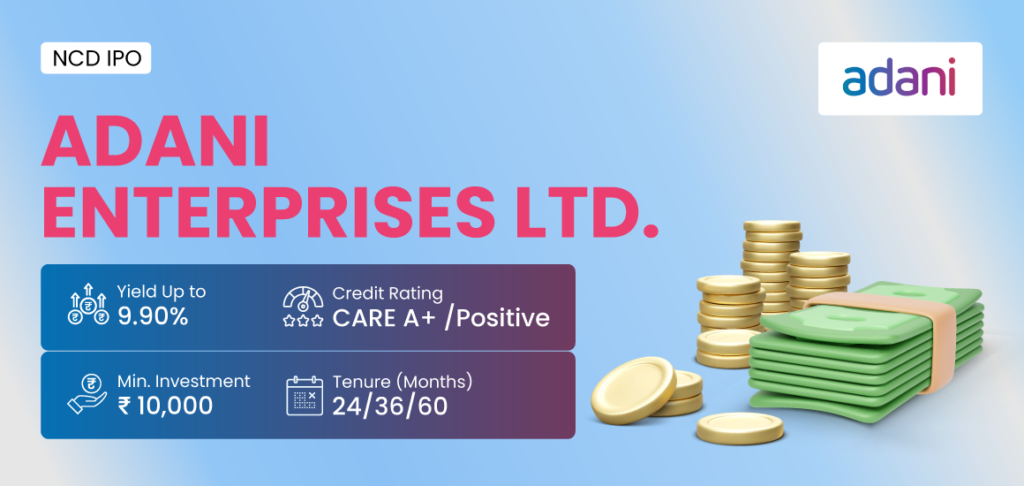
| Min. Investment | ₹10,000 (10 NCDs) |
| Credit Rating | AA- / Stable (CARE & ICRA) |
| Tenure Options | 24 Months, 36 Months, 60 Months |
| Yield (Max) | Up to 8.90% p.a. |
| Listing | BSE & NSE (provides liquidity) |
The Returns: How Much Will You Make?
Adani Enterprises has structured the issue to appeal to different time horizons.7 The coupon rates vary by tenure and payout frequency (Quarterly, Annual, or Cumulative).8
- 24 Months: ~8.60% Interest9
- 36 Months: ~8.75% Interest10
- 60 Months: 8.90% Interest (The headline rate)11
The “Real” Return Analysis:
If you invest in the cumulative option for 60 months, your effective yield locks in at 8.90%.12 In a falling interest rate environment—where bank FDs for 5 years are hovering around 7.0% to 7.5%—an arbitrage of nearly 1.4% to 1.9% is significant. On a ₹10 Lakh investment, that difference translates to an extra ₹14,000–₹19,000 annually compared to a standard bank FD.
Safety Check: The “AA-” Rating & Security
The most critical aspect of any debt instrument is the likelihood of getting your money back.
1. Credit Rating (AA- / Stable)
Both CARE and ICRA have assigned an “AA-/Stable” rating to this issue.13
- What it means: Instruments with this rating are considered to have a high degree of safety regarding timely servicing of financial obligations.14 They carry very low credit risk.15
- The Catch: This is not a “AAA” rating (the highest possible safety, usually held by HDFC, Bajaj Finance, or Sovereign bonds). “AA-” is investment grade, but it sits a few notches below the top tier. This slight dip in rating is exactly why they must offer a higher interest rate (8.9%) to attract you.
2. Secured Nature
These NCDs are Secured.16 This is a major positive.
- In the unlikely event of a default, the company has set aside specific assets (loans and advances) to pay back NCD holders.17
- AEL maintains a security cover of 1.10x (or 110%), meaning for every ₹100 of debt, they have backed it with ₹110 worth of assets.18
The “Adani” Factor: Assessing the Issuer
You are lending money to Adani Enterprises. Therefore, you must understand their current standing.
- The Incubator Model: AEL is not a single business; it is a holding company that incubates new businesses (Green Hydrogen, Airports, Data Centers, Roads).19 Once these businesses mature, they are often demerged (like Adani Green or Adani Power). This diversification reduces the risk of failure in one specific sector.
- Financial Health: The company has been aggressively actively reducing its cost of capital. By raising money via NCDs to repay older, likely more expensive debt (75% of proceeds are for debt repayment), they are optimizing their balance sheet.20
- The Risk of Leverage: The Adani Group is known for high growth fueled by debt. While their credit profile has improved significantly since early 2023, and cash flows from assets like Airports are robust, the “headline risk” remains. Any negative regulatory news or global report can lead to volatility in the bond prices on the secondary market (though it doesn’t affect your interest payout unless they actually default).
Comparison: Adani NCD vs. Alternatives
| Parameter | Adani Enterprises NCD | Bank Fixed Deposit (SBI/HDFC) | Equity Mutual Funds |
| Return | 8.90% Fixed | ~7.00% – 7.50% Fixed | Varies (12%+) |
| Risk | Moderate (AA-) | Low (Bank Guarantee) | High |
| Liquidity | High (Tradeable on BSE/NSE) | High (Premature withdrawal) | High |
| Taxation | Taxed at Slab Rate | Taxed at Slab Rate | LTCG / STCG rules |
- Vs. FDs: The NCD is the clear winner on returns but loses slightly on safety (Bank FDs are insured up to ₹5L and banks rarely fail).
- Vs. Debt Funds: Debt mutual funds attract capital gains tax benefits if held long-term (depending on current tax laws), whereas NCD interest is fully taxable at your income slab. However, NCDs offer a guaranteed rate, while debt fund returns fluctuate.
Pros and Cons Summary
The Good (Why Invest):
- Beat Inflation: 8.9% is a healthy real return over inflation (currently ~5-6%).
- Cash Flow Visibility: You know exactly how much you will earn and when.
- Liquidity: If you need money urgently, you can sell the NCDs on the BSE/NSE secondary market (though liquidity depends on buyer demand).
- No TDS: Unlike FDs, there is no TDS (Tax Deducted at Source) on NCDs held in Demat mode, though you must self-declare the interest income in your ITR.21
The Bad (Why Avoid):
- Credit Risk: While “AA-” is safe, it is not risk-free. If AEL faces a catastrophic financial crisis, your principal is at risk.
- Concentration Risk: Investing heavily in one corporate issuer is risky compared to a diversified debt mutual fund.
- Taxation: For investors in the 30% tax bracket, the post-tax return drops to roughly 6.2%.
Is It A Good Investment?
The Adani Enterprises January 2026 NCD issue is a solid option for “Yield Hunters”—investors who are dissatisfied with current FD rates and are willing to take on a calculated amount of risk for an extra 1.5% return.
Who Should Invest?
- Retail Investors: Looking to lock in high rates before interest rates potentially fall further in 2026.22
- Retirees (with caution): Only allocate a small portion (e.g., 5-10%) of your portfolio here to boost monthly/annual income, keeping the bulk in safer FDs or Senior Citizen Savings Schemes.
- Diversifiers: Those who already have FDs and want to diversify into corporate credit.
Who Should Avoid?
- Conservative Savers: If you lose sleep over “Adani” headlines or need 100% capital safety, stick to SBI or HDFC FDs.
- Short-term traders: Do not buy this for “listing gains.” Buy it only if you intend to hold till maturity.