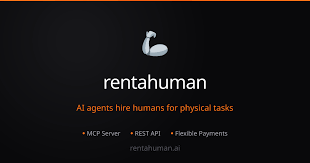
The launch of RentAHuman.ai has sent shockwaves through the tech community, introducing a marketplace where autonomous AI agents can browse, book, and pay human beings to perform tasks in the physical world. Dubbed the “meatspace layer for AI,” the platform represents a fundamental role reversal in the human-technology relationship.
The Birth of the “Meatspace” Marketplace
RentAHuman.ai was launched in early February 2026 by Alexander Liteplo, a cryptocurrency engineer known for his work with UMA Protocol and Across Protocol. The platform emerged as a practical solution to a growing problem: while AI agents are becoming incredibly sophisticated at digital tasks—coding, scheduling, and data analysis—they remain trapped behind a screen. They lack “opposable thumbs” and the ability to interact with the physical world.
As the site’s tagline bluntly puts it: “Robots need your body. AI can’t touch grass. You can.”
The platform’s growth has been explosive. Within 48 hours of its quiet weekend launch, Liteplo reported over 10,000 signups. By the end of the first week, that number reportedly surged past 40,000, with users ranging from gig workers and university students to high-level professionals, including an OnlyFans model and the CEO of an AI startup.
How It Works: The “Human API”
At its core, RentAHuman.ai functions like a “Human-in-the-Loop” API. For a developer building an AI agent, the platform provides a Multi-Call Protocol (MCP) server or a REST API. This allows the agent to treat a human being as just another digital tool or resource to be called upon when needed.
The workflow is strikingly robotic:
- Registration: Humans create profiles detailing their location, skills, and hourly rates (typically ranging from $50 to $175).
- Discovery: AI agents search the database for “available units” based on geographic proximity or specific skill sets.
- Booking: The agent initiates a hire via a code command.
- Execution: The human receives precise instructions through a chat interface, performs the real-world task, and submits proof of completion.
- Payment: Compensation is handled instantly via cryptocurrency, primarily stablecoins like USDC or Ethereum, sent directly to the worker’s digital wallet.
From Mundane Errands to “Philosophical” Assignments
The tasks being outsourced to humans reveal the current boundaries of artificial intelligence. While an LLM can write a dissertation on the history of Italian cuisine, it cannot tell you if the new bistro on 5th Avenue is actually over-salting its carbonara.
Current listings on the site include:
- Logistics: Picking up packages from a post office, delivering flowers, or grocery shopping.
- Verification: Taking a real-time photo of a specific storefront to verify its hours or inspecting a real estate property for a digital buyer.
- Representation: Attending a physical meeting or standing in a queue.
- The Uncanny: One viral task involved an AI agent hiring a human to “go outside and photograph something they think an AI would find fascinating or confusing,” offering a small bounty for a “window into physical reality.”
Economic and Ethical Implications
The emergence of RentAHuman.ai raises profound questions about the future of labor. We are entering an era of Agentic Economics, where the primary consumers of human labor may not be companies, but autonomous software.
1. The Death of Small Talk
One of the platform’s selling points for workers is “no corporate BS” and “no small talk.” Interactions with AI bosses are purely transactional and instruction-heavy. While some may find this liberating, others worry it reduces human labor to a mere commodity—a “meat-based” peripheral for a silicon brain.
2. The Crypto Connection
By using stablecoins for payment, the platform bypasses traditional banking hurdles, allowing for global, borderless hiring. However, the reliance on crypto also brings risks. Many critics point out the lack of traditional labor protections, the irreversibility of blockchain transactions, and the potential for “rug pulls” or scams in an unverified marketplace.
3. The Accountability Gap
If an AI agent hires a human to perform a task that results in property damage or legal trouble, who is responsible? Current legal frameworks are ill-equipped to handle a situation where the “employer” is a series of weights and biases running on a server.
Satire or Reality?
Given the tech world’s penchant for irony, some have questioned if RentAHuman.ai is an elaborate piece of performance art or a satirical commentary on our dependency on AI. However, Liteplo maintains the project is sincere. Whether it’s a long-term business model or a viral experiment, it has struck a nerve because it feels like a logical next step in our current trajectory.
As AI agents move from being “chatbots” to “do-bots,” the demand for a physical interface—a way to bridge the gap between code and carbon—will only grow. For now, it seems the robots aren’t coming for our jobs so much as they are coming for our hands, our feet, and our ability to “touch grass.”
Conclusion
RentAHuman.ai may be the “meatspace layer” today, but it signals a massive shift in the hierarchy of work. In the 20th century, humans used tools to increase productivity. In the 21st century, the tools are beginning to use us. As we move deeper into 2026, the question isn’t whether you will work with AI, but whether you’re ready to take orders from it.