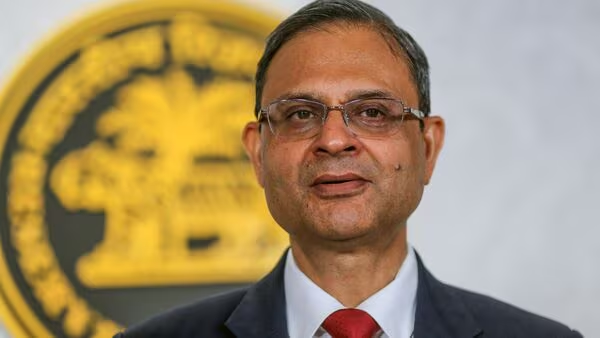
The Reserve Bank of India’s (RBI) Monetary Policy Committee (MPC), led by Governor Sanjay Malhotra, concluded its first bi-monthly meeting for the financial year 2026-27 (FY27) today. Against a backdrop of volatile global geopolitics and shifting energy prices, the central bank’s decisions provide a roadmap for India’s economic resilience.
In this blog, we break down the key announcements from the April 2026 RBI MPC meeting, the inflation outlook, and what this means for investors and borrowers.
1. Repo Rate Remains Unchanged at 5.25%
In a unanimous decision, the MPC opted to keep the repo rate unchanged at 5.25%. While there were market hopes for a cut to boost consumption, the committee chose a cautious approach due to supply-side shocks and global uncertainties.
- Policy Stance: The RBI maintained its stance as ‘Neutral’, signaling flexibility to move in either direction based on evolving data.
- Current Rates: * Repo Rate: 5.25%
- SDF Rate: 5.00%
- MSF & Bank Rate: 5.50%
2. GDP Growth Forecast for FY27
Despite global headwinds, the RBI remains optimistic about India’s domestic growth. The real GDP growth for FY27 is projected at 6.9%.
The quarterly breakdown is as follows:
- Q1 FY27: 6.8%
- Q2 FY27: 6.7%
- Q3 FY27: 7.0%
- Q4 FY27: 7.2%
Governor Malhotra noted that while elevated energy prices and disruptions in the Strait of Hormuz pose risks, the strong fundamentals of the Indian economy and robust services sector provide a solid cushion.
3. Inflation Outlook: The 4.6% Target
Inflation management remains the RBI’s primary focus. The CPI inflation for FY27 is projected at 4.6%.
The Governor highlighted that while the “war premium” on crude oil had slightly eased due to the recent US-Iran ceasefire, upside risks to inflation persist. The quarterly inflation estimates are:
- Q1: 4.0%
- Q2: 4.4%
- Q3: 5.2%
- Q4: 4.7%
4. Major Policy Moves: Ease of Doing Business
Beyond interest rates, the RBI announced several structural measures to improve the financial ecosystem:
- MSME Support: The onboarding process for MSMEs on the TReDS (Trade Receivables Discounting System) platform has been simplified by removing certain due diligence requirements.
- Expanding Money Markets: Non-bank participants, including NBFCs and Housing Finance Companies (HFCs), are now allowed to participate in the term money market to enhance liquidity.
- Digital Innovation: Continuous efforts to streamline regulatory instructions into a more accessible format for bank boards.
5. Market Reaction: Sensex and Nifty Surge
The stock market reacted positively to the RBI’s balanced tone and the news of a temporary ceasefire in West Asia.
- The Sensex jumped over 2,600 points (approx. 3.5%).
- The Nifty 50 rose by over 780 points.
- Banking stocks led the rally, with the Bank Nifty surging nearly 5% following the announcement.
What it Means for You
- For Borrowers: With the repo rate held steady, EMIs on home and auto loans are likely to remain stable in the near term.
- For Investors: The ‘Neutral’ stance and 6.9% growth forecast suggest a stable environment for equity markets, though volatility may persist depending on international oil prices.
- For MSMEs: Easier access to TReDS platforms will help in managing cash flows and reducing the credit gap.
Conclusion
The April 2026 RBI Policy reflects a “watchful” central bank that is prioritizing stability over aggressive easing. By maintaining the status quo, Governor Sanjay Malhotra has signaled that while the Indian economy is on a strong footing, the RBI will not lower its guard against global inflationary pressures.