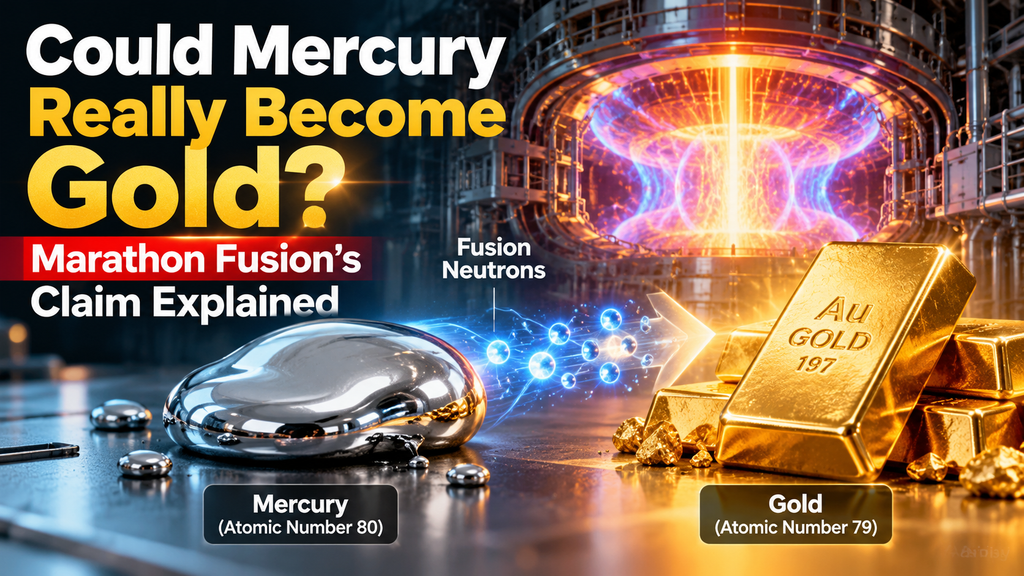
For centuries, turning ordinary metals into gold was considered the ultimate dream of alchemists. Today, modern nuclear science may be bringing a version of that ancient idea closer to reality.
San Francisco-based fusion startup Marathon Fusion claims it has successfully converted mercury into stable gold using neutrons generated through nuclear fusion. The company says its latest experiment achieved a production rate 10 times a benchmark associated with CERN’s 2025 work.
The claim has attracted attention not only from the scientific community but also from investors and gold-market watchers. If technology could eventually produce meaningful quantities of gold from mercury, could it increase global supply and put pressure on gold prices?
The answer is not as simple as the headline suggests. While nuclear transmutation is scientifically possible, producing gold at a commercially competitive scale presents enormous technical and economic challenges.
How Can Mercury Become Gold?
Mercury and gold are different chemical elements because their atomic nuclei contain different numbers of protons.
Mercury has 80 protons, while gold has 79 protons. To transform mercury into gold, scientists must therefore change the structure of its atomic nucleus. This is fundamentally different from a normal chemical reaction.
Marathon Fusion’s proposed process uses mercury-198, an isotope of mercury. High-energy neutrons generated during a deuterium-tritium fusion reaction can interact with mercury-198, producing radioactive mercury-197.
That isotope can then undergo radioactive decay and ultimately form stable gold-197.
In simple terms, the process is not about chemically mixing mercury with another substance. Instead, it involves changing the nucleus of the atom through a nuclear reaction.
This makes the concept scientifically very different from the traditional idea of alchemy.
What Has Marathon Fusion Reported?
Marathon Fusion says it has moved beyond theoretical calculations and conducted an experiment involving mercury and fusion-generated neutrons.
According to reports, the company said gamma-ray measurements indicated the presence of mercury-197 and gold-197 after irradiation. Marathon Fusion also claimed that its production rate was approximately 10 times the benchmark associated with CERN’s 2025 gold-transmutation work.
However, an important point should not be overlooked: the company has not publicly disclosed the total amount of gold produced in the reported experiment.
Therefore, the announcement should be understood as an experimental claim rather than evidence that commercially significant quantities of gold are already being manufactured.
That distinction is particularly important when discussing the possible impact on gold prices.
How Does This Compare With CERN?
CERN has previously demonstrated that nuclear reactions can create gold.
Researchers working with the ALICE experiment at CERN reported that lead nuclei could be transformed into gold nuclei during high-energy collisions.
The results were scientifically remarkable but produced an extremely small amount of material. Across CERN’s four major experiments, researchers produced approximately 86 billion gold nuclei between 2015 and 2018, with the total mass estimated at only around 29 picograms.
That figure demonstrates the enormous gap between proving that gold can be created through nuclear reactions and producing enough gold to influence the global market.
Marathon Fusion’s approach is different. Rather than relying on particle collisions, the company proposes using high-energy neutrons generated by fusion.
The company believes this could offer a more scalable route to producing gold while also generating energy.
Could This Technology Crash Gold Prices?
For now, there is little reason to expect an immediate collapse in gold prices.
Gold prices are determined by a wide range of factors, including investment demand, central-bank purchases, interest rates, inflation expectations, currency movements, geopolitical uncertainty, mine production and recycling.
Even if Marathon Fusion’s technology works as described, building enough fusion infrastructure to produce a significant portion of the world’s gold supply would be an enormous undertaking.
Commercial fusion power itself remains an emerging technology.
As a result, the mercury-to-gold experiment does not mean that the world is suddenly facing an unlimited supply of cheap gold.
The technology would have to pass several major milestones before it could have a meaningful impact on the gold market.
How Much Gold Could Fusion Technology Produce?
This is where the story becomes particularly interesting.
Marathon Fusion’s research has proposed that a 1-gigawatt thermal fusion plant could potentially produce around 2 tonnes of gold per year.
The company’s research suggests that gold production could potentially become an additional revenue stream for future fusion power plants.
However, these figures represent projections and engineering concepts rather than demonstrated commercial production.
The difference is crucial.
Producing a small amount of gold during an experiment is one challenge. Operating a fusion reactor continuously, generating sufficient neutron flux, processing mercury, recovering gold and maintaining economic viability is an entirely different challenge.
The Biggest Challenge: Economics
Even if the science works, the biggest question may ultimately be financial.
Gold mining already has an established global supply chain involving exploration, extraction, refining and recycling.
A fusion-based gold-production system would require extremely sophisticated infrastructure, advanced nuclear technology and significant capital investment.
The central economic question is therefore straightforward:
Would it cost less to produce gold through fusion than to mine and refine it naturally?
Until the answer becomes clear, fusion-produced gold is unlikely to compete directly with traditional mining.
There is also another important issue: the availability of the required mercury isotope.
Marathon Fusion’s proposed process relies on mercury-198, and obtaining and enriching specific isotopes on an industrial scale could introduce additional technical and financial challenges.
Could Gold Lose Its Scarcity?
Gold has traditionally been valuable partly because it is relatively scarce and difficult to produce.
If technology eventually makes it possible to manufacture large quantities of gold at a competitive cost, the economics of the precious-metals market could change.
However, that scenario is still hypothetical.
For the technology to materially affect global gold prices, several conditions would need to occur simultaneously:
- Commercial fusion reactors would need to become viable.
- Large quantities of fusion neutrons would need to be generated reliably.
- Mercury-198 would need to be available at scale.
- The nuclear conversion process would need to operate efficiently.
- Gold would need to be recovered economically.
- Production would need to reach a meaningful percentage of global supply.
Until then, natural gold mining will remain the dominant source of the metal.
The Bigger Opportunity May Be Fusion Energy
Interestingly, the most important part of Marathon Fusion’s research may not actually be gold.
The company is exploring ways to use fusion-generated neutrons to create valuable isotopes and materials.
Its research has also examined the production of copper-64 and copper-67, radioactive isotopes with potential applications in medical imaging and targeted cancer treatment.
This suggests a broader business model.
Future fusion reactors could potentially generate electricity while also producing valuable materials and medical isotopes.
If successful, these additional revenue streams could improve the economics of fusion energy.
That could ultimately be more significant than the idea of making gold itself.
What Should Gold Investors Watch Next?
Investors should avoid reacting to the headline alone.
Instead, the most important developments to monitor are independent verification of Marathon Fusion’s experimental results, detailed technical data, successful long-duration fusion operations and evidence that the proposed process can operate economically.
The key question is not simply “Can mercury become gold?”
Modern nuclear science already shows that elements can be transformed.
The much bigger question is:
“Can mercury-to-gold conversion become commercially scalable and cheaper than conventional gold production?”
If the answer eventually becomes yes, the impact on the precious-metals industry could be substantial.
If not, the technology may remain an impressive scientific achievement without becoming a serious threat to gold prices.
Conclusion
Marathon Fusion’s mercury-to-gold claim sounds like something taken directly from an ancient alchemy textbook. However, the underlying principle is based on modern nuclear physics.
The company says it has successfully used fusion-generated neutrons to transform mercury into stable gold and achieved a production rate significantly higher than a previous CERN benchmark.
Yet there is a long road between a successful experiment and a commercial gold factory.
For now, investors should not assume that fusion technology is about to flood the market with gold or cause prices to crash. Commercial fusion itself still faces major technological and economic hurdles, while large-scale mercury-to-gold production remains unproven.