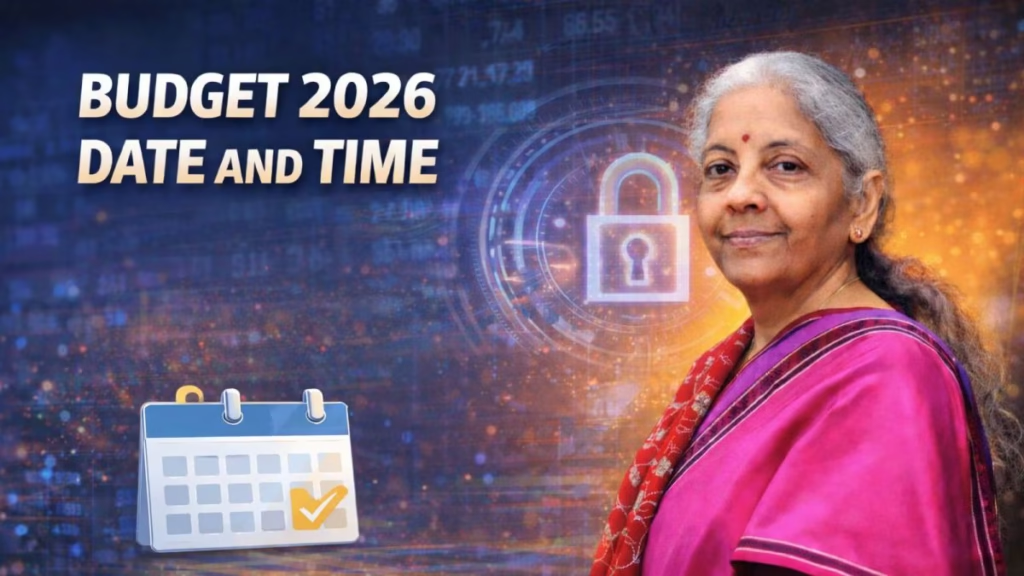
As the nation gears up for February 1, 2026, all eyes are on Finance Minister Nirmala Sitharaman. This year’s Union Budget is not just another fiscal announcement; it is a historic milestone and a strategic roadmap for “Viksit Bharat” (Developed India).
Based on the latest reports from major news outlets, here is a comprehensive look at what to expect, how to watch, and the key sectors seeking relief.
A Historic Milestone for the Finance Minister
Finance Minister Nirmala Sitharaman is set to create history by becoming the first woman FM to present the Union Budget nine times in a row (including one interim budget). This consistency signals the government’s commitment to long-term economic stability and a steady policy hand.
When and How to Watch
The budget will be presented in the Lok Sabha on Sunday, February 1, 2026, at 11:00 AM.
- Live Stream: You can watch the speech live on Doordarshan (DD News), Sansad TV, and official government YouTube channels.
- Digital Access: Post-speech, the full budget document and the Finance Minister’s speech will be available on the “Union Budget Mobile App” and the official budget website (indiabudget.gov.in).
Taxpayer Expectations: Seeking Clarity and Relief
The biggest buzz surrounds the Income-tax Act, 2025 (ITA 2025), which officially takes effect on April 1. Salaried taxpayers and households are looking for:
- Higher Thresholds: Many hope the tax-free income limit will be raised beyond ₹12.75 lakh (for salaried) to combat inflation.
- Simplified Transitions: A clear “old-to-new” tax regime comparison tool to help families choose the most beneficial path.
- Joint Taxation: A proposal by ICAI for joint tax filing for married couples is gaining traction, potentially benefiting single-income households.
Sectoral Focus: From Retail to Rural Jobs
Different sectors have put forward their “wish lists” to boost the economy:
- Consumer & Retail: Industry experts are looking for a “Customs Duty 2.0” overhaul—reducing the current eight duty slabs to five or six to lower manufacturing costs and simplify trade.
- Rural Economy: There is a significant focus on the transition from MGNREGA to the new VB G-RAM-G (Viksit Bharat – Guarantee for Rozgar and Ajeevika Mission – Gramin). Critics and supporters alike are watching how this will impact rural employment.
- Tech & AI: Startups are urging the government to remove the 18% GST on AI skilling courses to make India a global hub for artificial intelligence.
Economic Indicators & Market Sentiment
Economists predict a delicate balancing act. The government aims to keep the fiscal deficit below 4.5% of GDP, while the Economic Survey projects a growth rate of 6.8% to 7.2% for FY27.
- Market Open: In a rare move, stock markets (NSE and BSE) will remain open for trading on Sunday to react to the budget announcements in real-time.
Summary Table: Key Themes of Budget 2026
| Feature | Details |
| Primary Goal | Realizing the “Viksit Bharat 2047” vision. |
| New Law | Implementation of Income-tax Act, 2025. |
| Key Priority | Job creation, MSME support, and Green Energy. |
| Major Reform | Potential “Customs Duty 2.0” to streamline imports. |
Conclusion
Budget 2026 arrives at a time of global uncertainty and shifting trade dynamics. Whether it’s through “Bahi-khata” traditions or paperless digital presentations, the core mission remains: fueling India’s consumption engine and ensuring growth reaches every household.
Stay tuned for live updates as the Finance Minister takes the floor this Sunday!