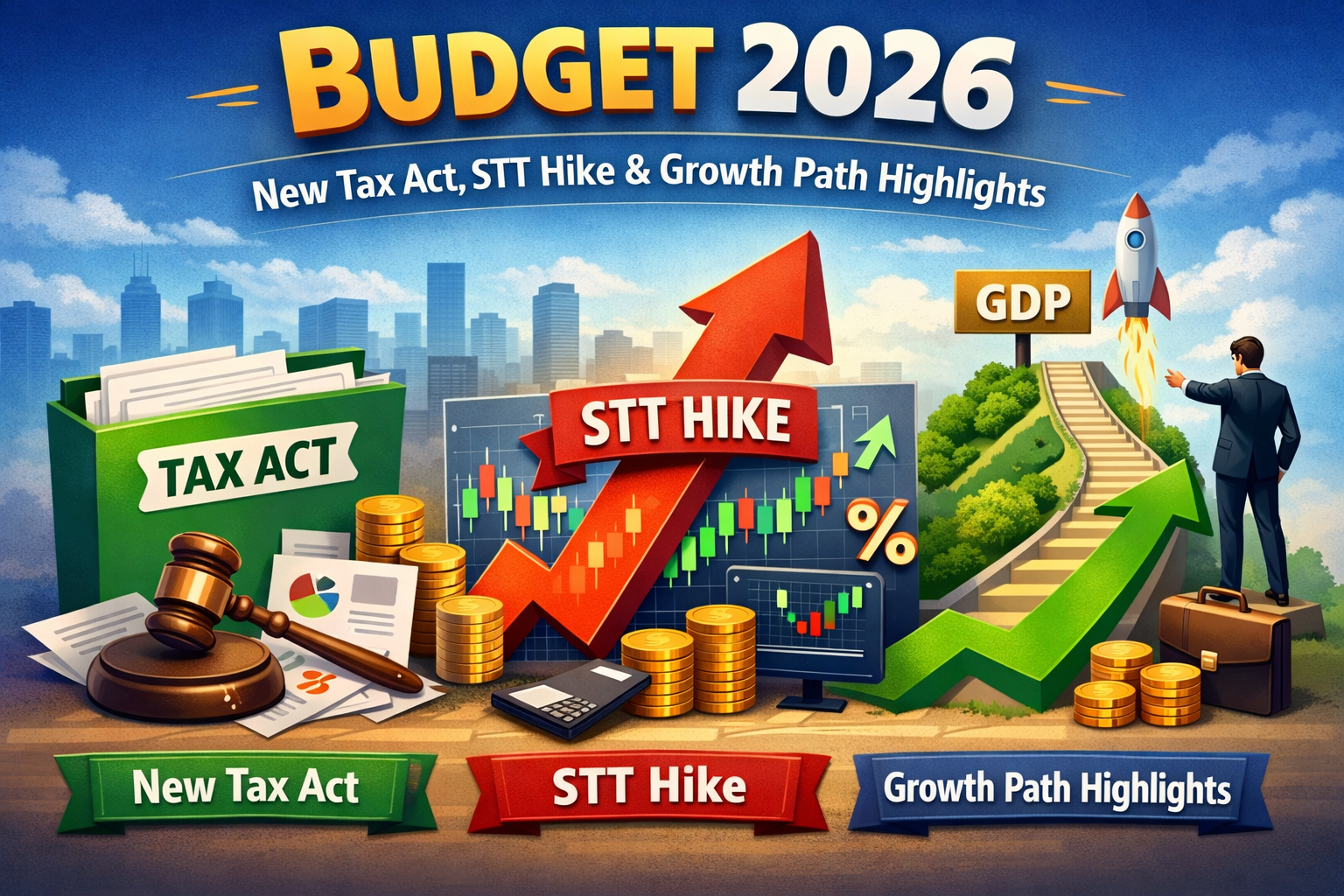
The Union Budget 2026-27, presented by Finance Minister Nirmala Sitharaman on February 1, 2026, marks a pivotal shift toward structural tax reform and aggressive sector-specific growth. While the “three-pronged Kartavya framework” focuses on long-term prosperity, the immediate market reaction was dominated by a sharp hike in trading taxes.
Direct Tax Revolution: The New Income Tax Act
The biggest headline for individual taxpayers is the sun-setting of the 65-year-old Income Tax Act of 1961.
- Implementation: The Income Tax Act, 2025 comes into effect on April 1, 2026.
- Simplification: The new law reduces the number of sections by nearly 50%, aiming to cut litigation and make filing “form-heavy” rather than “law-heavy.”
- Tax Slabs: In a move toward stability, the tax slabs remain unchanged. However, the new framework promises redesigned, user-friendly ITR forms.
- Compliance Relief: The deadline for filing revised returns has been extended from December 31 to March 31.
Market “Bloodbath”: The STT Hike
Investors and traders faced a “Sunday Shock” as the government moved to curb what it called “unchecked speculation” in the derivatives segment.
- Futures: STT hiked from 0.02% to 0.05%.
- Options: STT on Option Premiums increased from 0.1% to 0.15%.
- Impact: The Sensex crashed over 2,000 points intraday as brokerage stocks like Angel One and BSE Ltd tumbled by over 10%.
The “Three Kartavyas” & Macro Pillars
The Finance Minister outlined three primary duties (Kartavyas) to lead India toward Viksit Bharat (Developed India) by 2047:
- Sustaining Growth: Targeting a nominal GDP growth of 10%.
- Capacity Building: Massive focus on skill development and “Champion MSMEs.”
- Inclusive Access: Bridging the gap for rural regions and women-led enterprises.
Continuity Over Chaos – Decoding Budget 2026
If there is one word to describe Finance Minister Nirmala Sitharaman’s ninth consecutive budget, it is “Finesse.” Budget 2026 isn’t about flashy populist giveaways; it’s a cold, calculated blueprint for an efficient, modern economy.
The End of an Era: RIP Income Tax Act 1961
For decades, the Indian tax code was a labyrinth of confusing sections and “provisos of provisos.” By introducing the Income Tax Act 2025 (effective this April), the government is betting on simplification. While your tax rates haven’t dropped, the stress of filing might. With a 50% reduction in text and a more “rule-based” automated process for tax certificates, the “Aam Aadmi” finally gets a break from the paperwork, if not the payments.
The “F&O” Reality Check
The stock market didn’t take the news quite as gracefully. The steep hike in Securities Transaction Tax (STT) on Futures and Options is a clear message from the North Block: The casino is getting expensive. By more than doubling the tax on futures, the government aims to protect retail investors who, according to SEBI data, have been losing significant capital in the derivatives “explosion.” While the markets bled on Sunday, this move is designed to redirect capital from speculation back into long-term equity.
Key Budget Sections
1. The Tax Revolution: Income Tax Act 2025
The biggest structural reform is the total replacement of the 1961 tax code.
- New Legislation: The Income Tax Act, 2025 takes effect on April 1, 2026.
- Simplification: Drastic reduction in legal complexities and the introduction of user-friendly forms.
- Compliance: Revised returns can now be filed until March 31, providing much-needed breathing room for taxpayers.
2. Market Volatility: The STT Hike
To curb “hyper-speculation” in the derivatives market, the government significantly raised the Securities Transaction Tax (STT):
- Futures: Increased from 0.02% to 0.05%.
- Options: Increased from 0.1% to 0.15%.
- Market Impact: The Sensex witnessed a sharp intraday drop as traders reacted to the higher cost of F&O participation.
3. Manufacturing & “Shakti” Initiatives
- Biopharma Shakti: A ₹10,000 crore outlay to establish India as a global biopharma manufacturing hub.
- Semiconductor Mission 2.0: Aggressive expansion of the chip ecosystem.
- Rare Earth Corridor: Strategic development in Odisha, Kerala, Andhra Pradesh, and Tamil Nadu to secure critical minerals.
4. Infrastructure: The Rail & City Push
- High-Speed Rail: Proposal for 7 new corridors including Mumbai-Pune and Delhi-Varanasi.
- City Economic Regions (CER): Focused development for Tier-II and Tier-III cities with an emphasis on “agglomeration power.”
Manufacturing 2.0: Beyond the Basics
The Budget doubled down on “Sunrise Sectors”:
- Semiconductor Mission 2.0: Allocation increased to ₹40,000 crore.
- Biopharma Shakti: A new ₹10,000 crore outlay to turn India into a global clinical trial and manufacturing hub.
- Rare Earth Corridor: A strategic move to secure the minerals needed for the EV and tech revolution.
Final Verdict
Budget 2026 is a “Fiscal Glide Path” masterpiece. It trims the fiscal deficit to 4.3% while simultaneously pushing capital expenditure to record highs. It’s a budget that rewards the patient manufacturer and the long-term investor, while gently (or not so gently) nudging the speculative trader toward the exit.