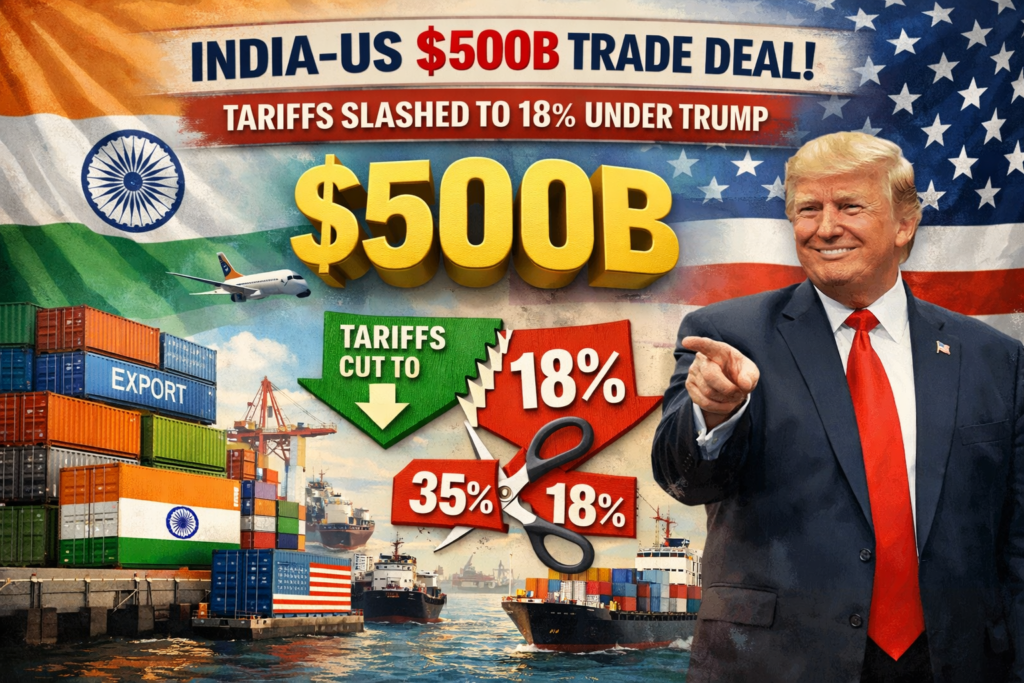
NEW DELHI / WASHINGTON — In a move set to reshape global geopolitics and economic alliances, Prime Minister Narendra Modi and U.S. President Donald Trump announced a comprehensive trade agreement on February 3, 2026. The deal, described by Indian officials as a “win-win,” aims to resolve a year of escalating trade tensions and positions India as a primary strategic partner for the United States in Asia.
The agreement follows a high-stakes phone call between the two leaders, coming just days after India signed a major trade pact with the European Union.
Tariff Reductions: The 18% Breakthrough
The cornerstone of the deal is a significant reduction in U.S. reciprocal tariffs on Indian goods.
New Rate: The U.S. will lower tariffs on “Made in India” products from 25% to 18%.
Strategic Advantage: This new rate notably places India in a more favorable position than neighboring Pakistan, which currently faces a 19% tariff.
Immediate Effect: President Trump confirmed the deal is “effective immediately,” removing punitive levies that had been a major point of friction over the past year.
The “Buy American” Commitment
President Trump, via Truth Social, revealed that India has committed to a massive purchasing plan to balance the trade deficit.
$500 Billion Target: India has pledged to purchase over $500 billion worth of American goods and services.
Key Sectors: The purchases will focus on U.S. energy (LNG and coal), advanced technology, and agricultural products.
Zero-Tariff Ambition: Trump claimed that India would move toward reducing its own tariffs and non-tariff barriers on U.S. goods to zero, though Indian officials have remained more cautious in their public wording regarding the timeline for this.
The Pivot from Russian Oil
In perhaps the most significant geopolitical shift of the deal, the White House confirmed that India has agreed to halt its purchase of Russian oil.
Ending Punitive Levies: A 25% “punitive tariff” previously linked to India’s continued trade with Russia will be dropped as part of this agreement.
Alternative Sources: India will shift its energy procurement to the United States and potentially Venezuela.
War Diplomacy: Trump explicitly linked this move to broader efforts to end the Russia-Ukraine conflict, thanking PM Modi for his “friendship and respect” in making this strategic pivot.
Reactions from New Delhi
Prime Minister Modi took to social media to express his gratitude, stating that the deal would “unlock immense opportunities” for India’s 1.4 billion people.
Official Confirmation: Union Minister Ashwini Vaishnaw confirmed the conclusion of the deal, calling it a historic milestone for Indian industry.
Market Response: Indian markets reacted with euphoria; the GIFT Nifty jumped 800 points in early trading, signaling massive investor confidence in the deal’s impact on Indian exports.
What Lies Ahead
While the broad strokes of the agreement have been announced, the detailed legal text is yet to be released
Ministerial Talks: External Affairs Minister S. Jaishankar is expected in Washington D.C. shortly to finalize cooperation on critical minerals and defense technology.
Global Impact: By aligning more closely with the U.S. on energy and trade, India effectively hedges against regional instability and solidifies its role as a counterweight in the global supply chain.