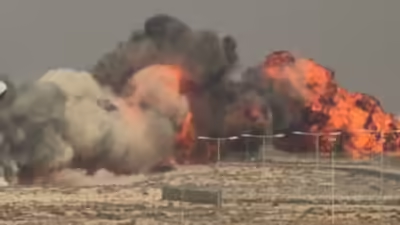
On 21 November 2025, a tragic incident cast a shadow over the grand finale of the Dubai Air Show. An Indian HAL Tejas light combat aircraft (LCA), performing in a demonstration flight at Al Maktoum International Airport, plummeted to the ground in a fiery crash — killing the pilot.
What Happened: The Crash at the Air Show
- The aircraft was performing its display at around 2:10 pm local time, executing a low-altitude manoeuvre when it suddenly lost control, nose-diving rapidly.
- Witnesses recorded the plane going down in a steep dive, followed by a massive fireball on impact and thick black smoke rising from the crash site.
- Emergency teams responded quickly; firefighting crews doused the wreckage, and the air show was momentarily suspended for safety.
- The Indian Air Force (IAF) confirmed that the sole pilot sustained fatal injuries.
- A Court of Inquiry has been set up to investigate the cause.
Who Was the Pilot
According to reports, the pilot was Wing Commander Namansh Syal, posted to the Sulur Air Force Station in Tamil Nadu. The Times of India+1 Sadly, he could not eject and died in the crash. The Times of India
Possible Cause: Negative-G Turn & Control Loss
- Early analysis suggests the jet lost control while attempting a negative-G turn, a high-risk manoeuvre where the pilot pulls the aircraft into a roll while experiencing forces that push them upward in the seat.
- According to eyewitnesses and video footage, the aircraft failed to maintain its angle of attack, leading to the dive.
- Experts have pointed out that Tejas’s delta-wing design, while aerodynamically efficient at high speeds, may bleed energy quickly at low speeds, making recovery from aggressive manoeuvres more difficult.
Context: Why This Crash Is Especially Significant
- Symbol of Indigenous Capability
The Tejas is a key part of India’s push for self-reliance in defense manufacturing. Built by Hindustan Aeronautics Limited (HAL), it represents a milestone in indigenous aviation. - Second Known Crash
This is not the first Tejas accident — in March 2024, another Tejas Mk-1 crashed during a training exercise in India, though in that case, the pilot ejected safely. - Engine Dependency Questions
The jet uses a General Electric F404 engine. Some analysts are already raising questions about reliance on foreign engines, supply chain risks, and what this means for India’s push to build more of its own defense technology. - Misinformation & Prior Claims
Interestingly, a day before the crash, videos circulated alleging an “oil leak” from a Tejas at the airshow. The Press Information Bureau (PIB) clarified that the fluid seen was condensed water being drained — a routine procedure in humid climates like Dubai’s.
Responses and Reactions
- The IAF expressed deep regret and extended condolences to the pilot’s family.
- India’s Defence Minister, Rajnath Singh, called the pilot “brave and courageous” and said the nation stands with the bereaved family.
- Both Indian and UAE authorities will be involved in the investigation, as the crash happened on Emirati soil.
- General Electric (GE), which makes the engine, stated it would support the inquiry.
Broader Implications
- Safety at Air Shows: The tragedy underscores how dangerous aerobatic displays can be, especially when performed at low altitudes.
- Strategic Readiness: For India, the Tejas is not just an aircraft — it’s a symbol of increasing defense self-reliance. A crash like this may prompt more scrutiny of maintenance, training, and operational risk.
- Public Perception: The crash could influence how international buyers view the Tejas program. On one hand, the aircraft’s performance was being showcased on a global stage; on the other, such a high-profile accident raises questions.
- Supply Chain Risk: The dependence on foreign-made engines (like GE’s) is likely to be debated again, pushing for more indigenous alternatives in future aircraft development.
Conclusion
The crash of the Tejas fighter jet at the Dubai Air Show is a deeply tragic event. Beyond the personal loss of a skilled pilot, it raises serious questions about risk management, aircraft design, and India’s broader ambitions in defense manufacturing. As the inquiry unfolds, the findings will be closely watched — not just in India, but by the international aerospace community.